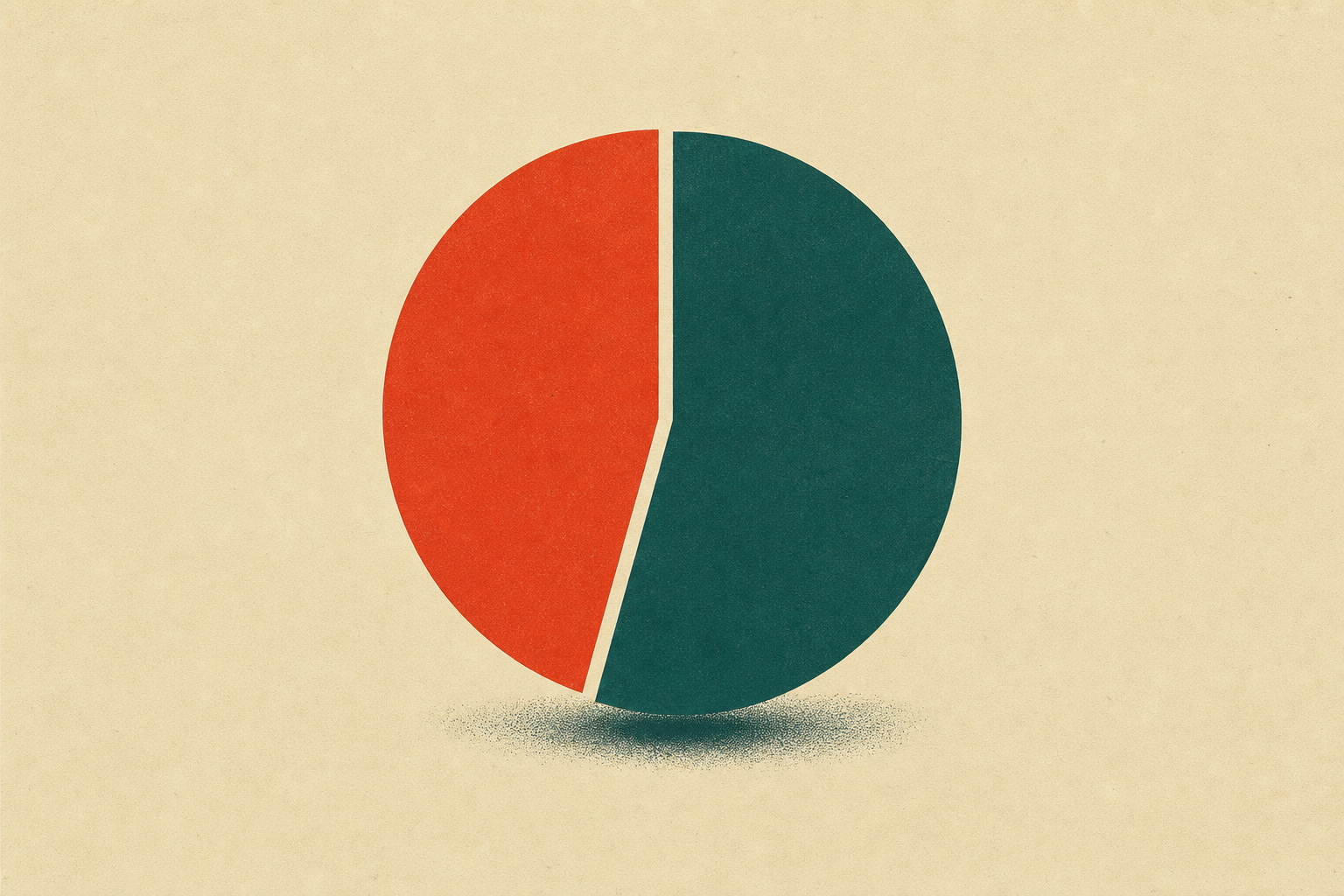
I sat in on a meeting last month with leaders from a mission-driven network and pulled up a stat that put the whole room on pause.
Forty-five percent of operating businesses now use AI in some real way. Fifty-five percent do not use it at all.
That is not a future problem. That is a current advantage for whichever side of the line you choose to live on. And it is wider than you think, because the gap is not a head start that closes over the summer. It is compounding every single week.
Let me show you what I mean.
The gap is not where most people assume
When I ask owners and ministry leaders where they sit, almost everyone places themselves somewhere in the middle. "We are dabbling." "We have used ChatGPT a few times." "Our marketing person is trying some stuff."
That is not the 45 percent. That is the 55 percent telling itself a kinder story.
The 45 percent are doing something different. They are running specific workflows through AI. They have one or two people on the team who push the edge every week. They are not asking whether to adopt. They are asking which thing to automate next. The gap between those two postures is not a few percentage points. It is a different operating system.
I have five kids and I have watched two of them now hit college. The difference between the kid who studies most weeks and the kid who crams two nights before finals is not the hours on paper. It is the compounding. By Thanksgiving the first kid is on a track and the second one is climbing back to even.
That is what this gap looks like in business right now.
Security is the most common excuse, and the most flimsy one
Every time I have this conversation, security comes up first.
"We cannot just put our data into one of these tools." "Our compliance team would never go for it." "We have client information we have to protect."
I take that seriously. I really do. But here is the reframe I keep coming back to: most of the emails you send every day are less secure than a paid AI account.
You email a contract to a vendor over Gmail. You text sensitive information to a team member. You leave a folder of client files in a shared drive that has not had its permissions audited since 2022. Then you tell me you cannot try a paid Anthropic or OpenAI account because of security.
Be a Wise Steward of your data. Pay for the tools. Turn off model training. Use the enterprise tier. Run a small test with non-sensitive content first. None of that is hard. Most of it takes an afternoon. The security objection is real but it is not the actual reason for the hesitation. The actual reason is that we are afraid to look dumb in front of our team while we learn something new.
That is fine. Just call it what it is.
The 130 percent story
A friend of mine runs a small services business with eight people on staff. Last fall he started training his team on AI in earnest. Not a one-time lunch and learn. A real internal sprint with weekly check-ins.
Six months in, his team is doing roughly 130 percent of the output they used to do with the same headcount. Nobody got laid off. Nobody got replaced. They are just bigger.
That is the part nobody talks about. The adoption story most people tell in their head is replacement. AI shows up, jobs leave, the business shrinks to fit the savings. The actual story I see on the ground is expansion. AI shows up, the team learns it, the same humans do more important work, and the business takes on opportunities they had to turn down before.
If you are in the 55 percent, you are not standing still. You are watching the 45 percent quietly take on the work you wish you had capacity for.
action
1. Pay for one tool this week: ChatGPT Business, Claude Pro, or a Copilot license. 2. Pick one workflow you personally do every week. 3. Run that workflow through the tool once. Not perfectly. Once. 4. Write down what was better, what was worse, where it surprised you. 5. Show the page to one teammate and ask them to pick their own workflow next week.
You do not have to be the AI expert on your team. You almost certainly will not be. But you do have to be the person who decided to stop sitting on the wrong side of the gap.
So which side are you actually on, and what is the one thing you will do this week to stop letting that question go unanswered?