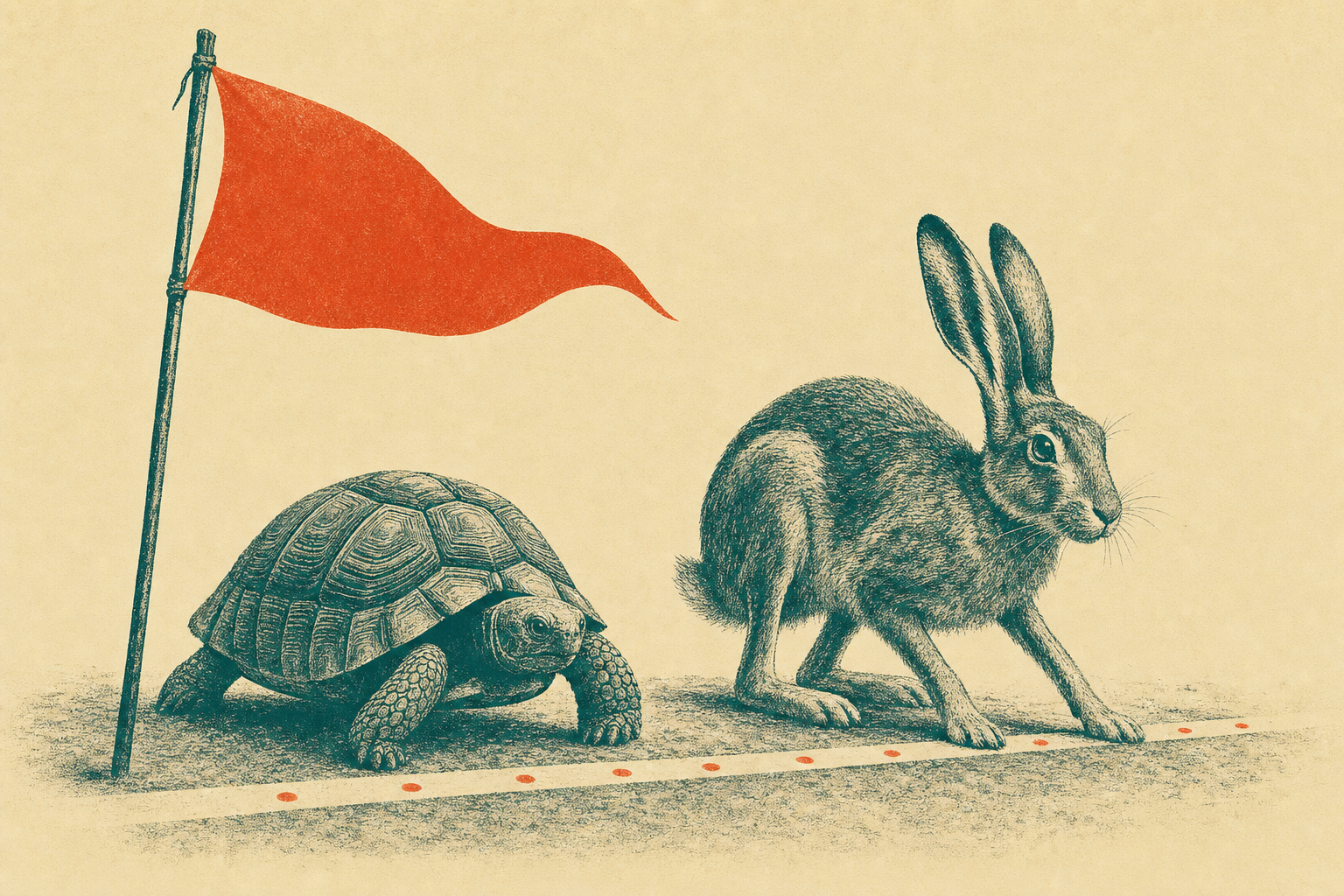
Apple did not invent the smartphone. They were not first. They were not even early. By the time the iPhone shipped, BlackBerry was a cultural phenomenon, Palm had been making smart devices for years, and a dozen other companies had already taken their swing. Apple was late. Apple was best. There is a difference, and the difference is the entire story.
I think about that a lot when I watch the hot company of the moment burn through a billion dollars in eighteen months on a customer-acquisition rocket ship that has no fuel for the trip back.
Here is a story I keep in a folder for any time I am tempted to grow my agency faster than it should grow. Zynga. They made FarmVille. Remember FarmVille? At their peak, they were the example everybody pointed at. They were on Facebook. They were everywhere. They were so confident in the trajectory that they bought a two-hundred-and-twenty-eight-million-dollar headquarters in San Francisco. Right before the layoffs.
The fastest-growing companies on revenue are not the same as the most-valuable companies on the long arc. Cyrus Ramezani and his colleagues at Cal Poly did the research years ago. The companies that grow fastest tend to underperform on share price over time. The companies that grow steadily tend to outperform.
Fast is not the same as good. Loud is not the same as durable. There is a real difference between a sprinter and a marathoner, and almost every founder I know is being sold a sprint.
The pressure is about to get worse
Here is what I want you to brace for.
In 2026, the AI tooling on your desk is making it easier than ever to ship fast. Faster code, faster content, faster outreach, faster everything. I see it in my own agency. We can ship work in an afternoon that used to take a team a month.
Which means the pressure to grow fast is about to triple. If you can ship in a day, why not sign five times as many clients? If you can build a website in fifteen minutes with Claude Code, why not take every prospect?
The answer is that capacity is not the same as capability. You can ship the work fast. Your operations cannot absorb the volume fast. Your billing cannot. Your culture cannot. Your retention cannot. Your founder energy cannot.
The owners who win the next decade are going to be the ones who feel the new ability to grow fast and decide, on purpose, to grow at the speed their organization can absorb. That is a humbly confident posture. Confident enough to know we could grow faster. Humble enough to know we should not.
My own posture
I have a line I tell myself a lot. I am the least comfortable when I am the most comfortable.
When the deals are closing, the team is stable, the cash is healthy, and the calendar feels easy, that is exactly when I get nervous. That is when I am most likely to make the bad decision. The bad decision is almost always to grow into territory we have not earned. Take on the client we should pass on. Hire the role we don't need yet. Launch the service line because a competitor did. Buy the office space because we can technically afford it.
The discipline of growing slow is the discipline of not making those bad decisions when you have the resources to make them. It is harder when you can. It is easy when you can't.
The right number for me is not "better than everybody else." It is "better than last year." That is the only fair benchmark for a long-term operator. You against the version of you that ran the place last January. Did you get more profitable? Did your client retention improve? Did your team get stronger? Did your offer get sharper? Did you, the owner, get healthier? If yes, you grew. The growth might not look impressive on a chart. But the trajectory is the only thing that matters when you are running a marathon.
action
1. Compare today's business to the one you ran last January, line by line. 2. Pick one number that proves growth: profit, retention, team strength, or owner health. 3. Name one client or hire you would have taken in panic. Pass on it on purpose. 4. Invest one week in boring infrastructure: billing, onboarding, or training. 5. Decide what "better than last year" looks like by December.
dont Confuse fast with strong. The rocket ships I watched implode were not the slow-growth companies. :::
Look at your business right now. Honestly.
Are you growing slowly on purpose, or are you standing still by accident? Is the slow pace a discipline you have chosen, or is it a hiding place from a decision you have been postponing?
Both can look the same on a chart. They are not the same at all in real life.
If you are growing slowly on purpose, hold the line in 2026. The pressure is about to get loud. Stand your ground. Confidence quietly. Humility actively. The decade is yours.
If you are standing still by accident, this is the week to admit it and pick the one move that gets the company back into deliberate motion. Not faster. Just deliberate.
Which one are you in?