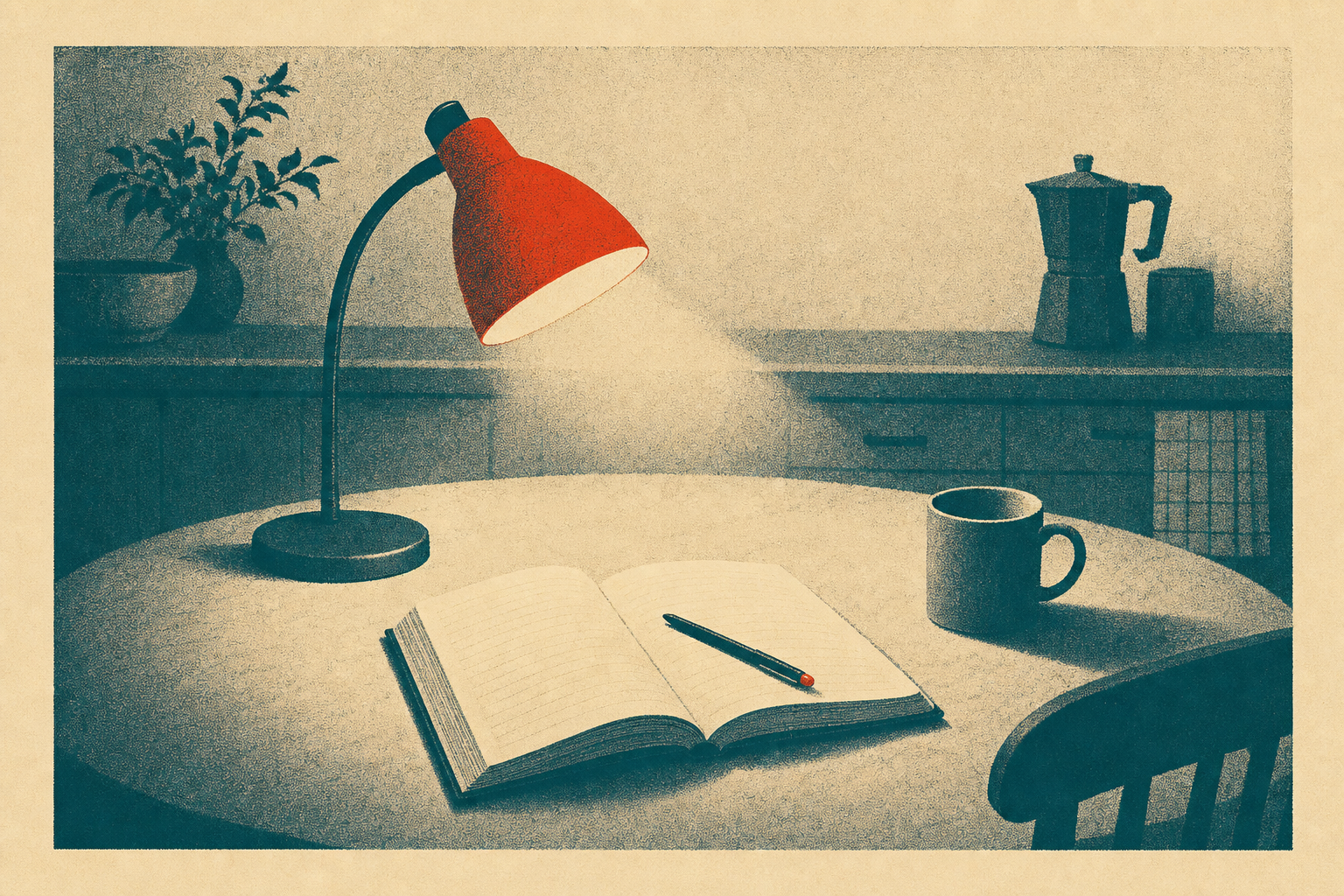
There is a kitchen table in my memory that I want to tell you about. It is a long time ago. I am in seventh grade. The lamp is on. There is a grammar workbook open in front of me. My mom is sitting across from me, patient and exhausted in equal measure.
I am crying.
I am not crying because I do not understand the assignment. I understand the assignment perfectly well in my head. The problem is what happens between my head and the paper. The words come out scrambled. The letters do not land where I am sending them. I read a sentence I just wrote and it does not say what I meant. I try again. The same thing happens.
This was decades before anyone in my family had a name for what was happening. I would not be diagnosed with dyslexia until I was an adult, and even then it would arrive less as a relief and more as a quiet "oh, that explains a lot." That night at the kitchen table, all I knew was that I was a kid who could not get his ideas onto a page, and the workbook in front of me was telling me that meant I was not very smart.
I was not the kid in school who waved his hand. I was the kid who knew the answer and would not raise his hand because I did not want to be asked to write anything on the board. I learned, very early, to route around the part of me that did not work the way it was supposed to. It became a habit. It probably saved me from worse outcomes. It also cost me a lot of years of believing my own thinking.
I am telling you this because of what happened at our kitchen table last fall.
My son Oliver
My son Oliver is also dyslexic. He is the diagnosed version of what I was. Same wiring. Same gap between what is in his head and what shows up on the page. When his teachers ask him a question out loud, the answer is sharp, organized, often funnier than the adults expect. When the same question shows up as a writing assignment, the gap opens up and Oliver is suddenly twelve years old and silent with a pencil in his hand.
A few months ago I watched Oliver do something I never could.
He had an essay due. He sat down at our kitchen table with his laptop, opened a chat window, and just started talking. Not typing. Talking. He was telling the AI what he wanted the essay to be about. He was thinking out loud. He was getting his real ideas, the ones that live in his head and never make it to the page, into a transcript. Then he started shaping them. He would say, "okay, that part should be the second paragraph, not the first." "That sentence is not what I mean. I mean it more like this." "The conclusion should land on the second point, not the third." Back and forth. The AI was not writing his essay. He was writing his essay, with the friction taken out.
What he turned in was his thinking. Not someone else's thinking. Not the AI's voice. His voice, finally on a page, without the seventh-grade gap between his head and the paper holding him hostage.
I sat across the table and tried not to cry. The version of me that sat at that other kitchen table forty years ago needed exactly that tool, and it did not exist. Oliver got it. The barrier that blocked me for a decade did not get to block him.
That is what I mean when I say AI is not coming to replace your humanity. The best version of AI in your business removes barriers that used to block your team from doing the most human work they were capable of.
action
1. Write "automate tasks, not relationships" somewhere you read it weekly. 2. Run the two-question filter on every new AI use: does it free people to do more of what only people can do, and does it honor everyone's dignity? 3. Identify one barrier on your team this week that AI can remove so the human work can show up. 4. List the relationship moments that you will never delegate to a workflow. Defend the list. 5. Call the person, do not draft the message, when somebody you serve is in a hard moment.
What is one barrier in your work or your team's work that AI could remove this week, so the human work underneath can finally show up?